
Vegetables
Season-wise vegetable planning and nutrition for small AP and Telangana growers
Three seasons, three plans
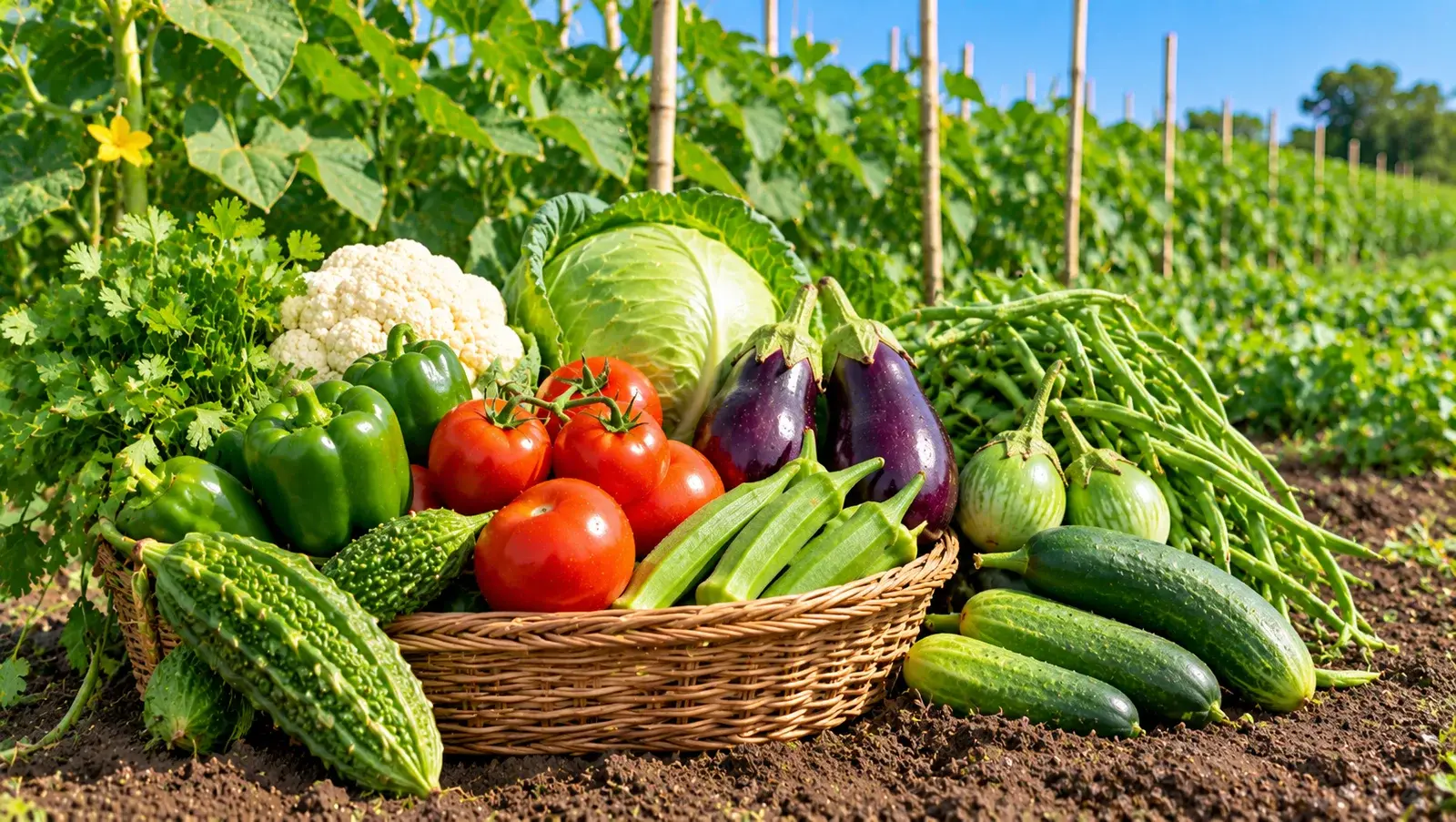
Most of AP and Telangana has no frost, so vegetables can be grown round the year. The Telangana Horticulture Department season chart is a handy base. Kharif (June-October): tomato and brinjal June-October, bhendi June-August, snake, bitter and ridge gourd July-October, cucumber June-October, cluster beans June-September, cabbage July-August, cauliflower August-September, onion and carrot from June-July. Rabi (November-February): tomato and brinjal November-February, methi October-February, cabbage and cauliflower October-November, carrot, radish and beetroot August-November, cluster bean, creeper beans and French bean October-November, onion December-April. Summer (February-June): tomato and brinjal February-June, bhendi January-March, snake gourd February-June, bitter and ridge gourd February-May, cucumber January-May, cluster bean January-June. Amaranthus, palak and gogu go all year.
ICAR-IIHR confirms that where there is no frost three tomato crops are possible, transplanted in June-July, October-November and February-March, and that October-November transplanting gives the best yield and quality. It also warns that high rainfall increases leaf and fruit rots and that rising temperature increases the insect vectors behind viral diseases, so kharif tomato needs raised beds and drainage, and summer crops need vector watch from the nursery.
A simple calendar for a small farm
May: prepare potting mix and nursery beds; June: sow chilli, tomato, brinjal, bhendi and cluster bean; July: weeding; August: hoeing and fertiliser.
September: potting mix for cole and root crops; October: sow cabbage, cauliflower, carrot, beetroot and onion; November-January: weeding, hoeing and fertiliser; February: harvest.
Keep one bed of leafy greens (amaranthus, palak, gogu, coriander) going every month for home use and quick cash.
Rotate: do not follow tomato with brinjal or chilli on the same bed. IIHR advises rotation with a cereal to stop the build-up of soil-borne disease, and notes that water-logging raises bacterial wilt.
Basal and top-dressing practice
Nutrition starts with organic matter. IIHR recommends about 25 tonnes of well-decomposed FYM per hectare, enriched with bio-fertilisers and bio-agents for 15 days before use, mixed in before beds are made. Soil-test first and follow the state recommendation; the split below is the practice, not a dose.
Basal, before transplanting: all the phosphorus, and for open-pollinated varieties all the potash with half the nitrogen. For hybrids IIHR puts one-third of nitrogen and one-third of potash as basal with the full phosphorus.
First top-dressing at about 4 weeks after transplanting, with earthing-up: the second half of nitrogen for varieties; one-third nitrogen and one-third potash for hybrids.
Second top-dressing at 8-9 weeks for hybrids: the last third of nitrogen and potash. This matches the heavy fruiting period in tomato, brinjal and chilli.
Fertigation through drip gives better fertiliser use efficiency and higher yield.
Do not pile nitrogen late in the crop; soft growth invites sucking pests and fruit rots. Keep moisture even through flowering and fruit set.
 AJ Flower MaxView details
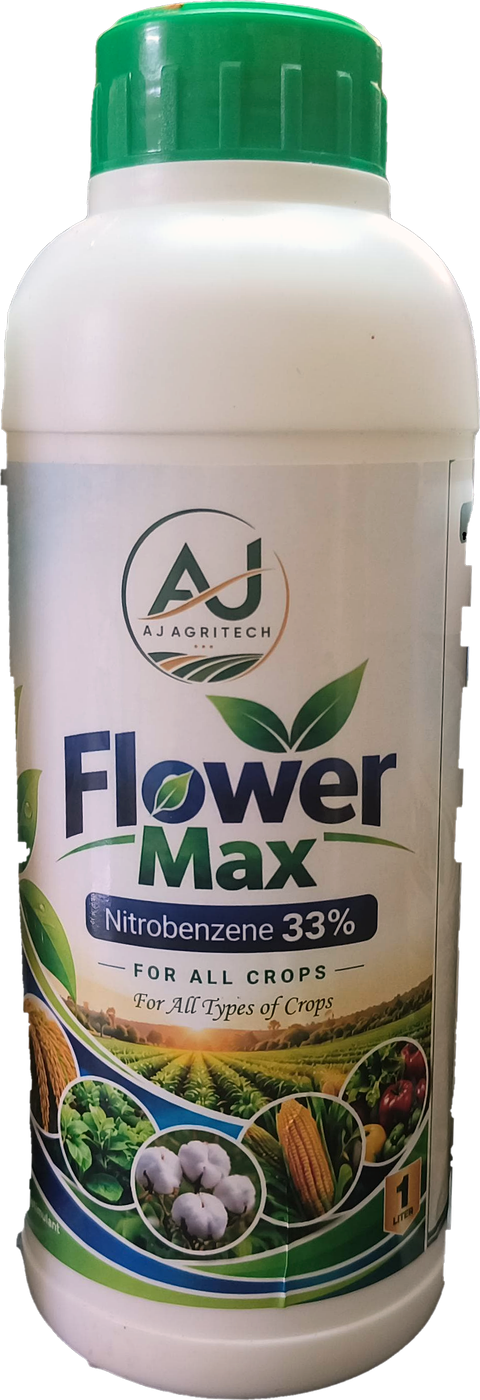
AJ Flower Max is a flowering booster for the flowering stage of the crop; it may be used as per label at the flowering stage of tomato, brinjal, chilli and gourds.
Reading nutrient deficiency in the field
The ICAR-CIAH bulletin Micronutrients in Vegetable Crops gives a simple first rule: look at where the symptom sits on the plant. Nitrogen, phosphorus and magnesium shortages show on the lower, older leaves and move upward; boron and calcium troubles start at the growing tip and move down; zinc shows on the second or third mature leaf from the top; iron and manganese show on the youngest leaves. The bulletin notes that at least half of Indian soils are short of zinc.
Zinc: short internodes and small leaves; tomato leaves become small, pale and curl inward; onion leaves turn yellow; cucurbit middle leaves go golden yellow. Worse on alkaline, sandy soils and where heavy phosphorus is used.
Iron: young leaves yellow between the veins while the veins stay green; in severe cases the whole young leaf bleaches. Common on alkaline or calcareous soil and when roots sit in water.
Manganese: yellowing between veins on younger leaves with greyish patches near the base; tomato leaves roll forward.
Boron: the growing tip dies, the plant looks bushy with thick, curled, brittle young leaves, flowers drop or stay barren; cauliflower curds brown and hollow, tomato fruits pitted and corky with uneven ripening. Worse in drought and coarse soils.
Look-alikes: the bulletin cautions that waterlogging, drought, root disease and herbicide injury can mimic deficiency, so confirm with a soil test or leaf test before buying inputs, and it warns that micronutrients applied without a deficiency can be toxic to the plant.
 AJ Micromix F6View details
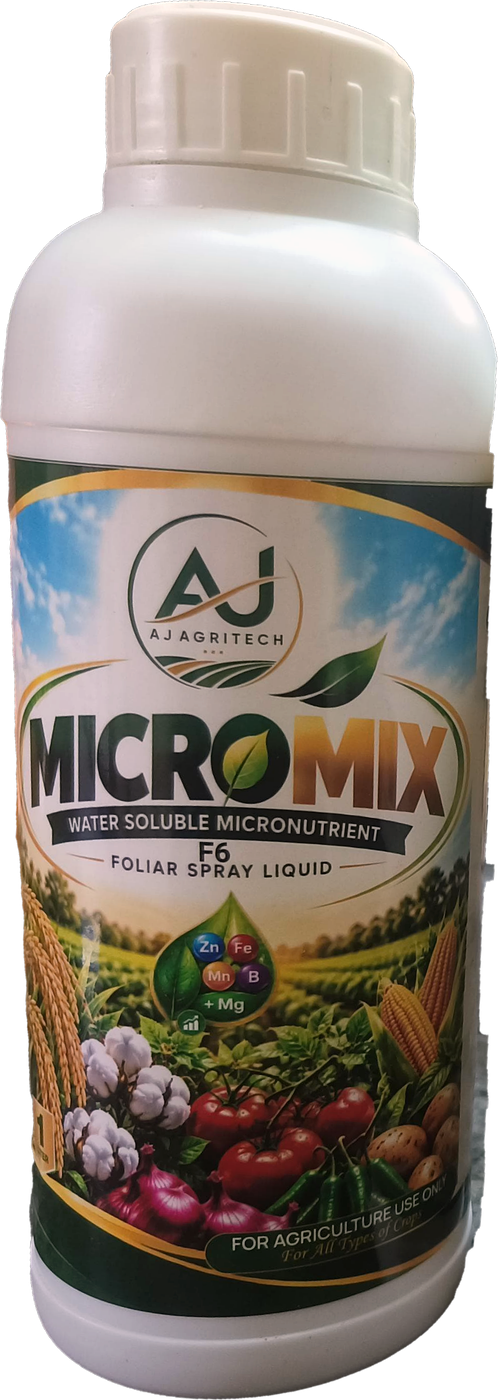
Where deficiency is confirmed, foliar correction works faster than soil application for iron. AJ Micromix F6, a water-soluble micronutrient foliar spray with Zn, Fe, Mn, B and Mg, may be used as per label; boron is best given basal at land preparation as the bulletin advises.
Quick checklist
Kharif sowing June-July; rabi October-November; summer January-March.
October-November tomato transplanting gives the best yield and quality; kharif crops on raised beds.
About 25 t FYM per hectare enriched with bio-agents; soil test before fertiliser.
Basal: full P, part N and K; top-dress at 4 weeks and 8-9 weeks with earthing-up.
Old leaves yellow = N, P or Mg; tip dies = B or Ca; veins green and leaf yellow on top = Fe or Mn; small leaves, short internodes = Zn.
Rule out waterlogging, drought and root disease before calling it deficiency; test the soil.
Rotate solanaceous crops with a cereal; keep a leafy-vegetable bed every month.
Sources
Urban Farming: Horticulture crops, season-wise details (kharif, rabi, summer vegetables and month-wise activities) — Horticulture Department, Telangana
Production technologies: Tomato (Arka Vikas): season, nursery, manures and fertilizers — ICAR-Indian Institute of Horticultural Research (IIHR), Bengaluru
Micronutrients in Vegetable Crops (Technical Bulletin No. 44, 2013) — ICAR-Central Institute for Arid Horticulture (CIAH), Bikaner